Understand the differences between cesarean delivery and normal delivery, their indications, benefits, risks, and recovery. Consult Dr. Smitha Raghavan for expert pregnancy care and cesarean delivery in Dubai.

Pregnancy is one of the most exciting journeys in a woman’s life. As your due date approaches, one of the biggest decisions many expectant mothers think about is whether they will have a normal vaginal delivery or a cesarean delivery (C-section).
Many women ask,
“Which delivery is better?”
The answer is not the same for everyone.
There is no universally “best” method of childbirth. The safest delivery is the one that ensures the health and well-being of both the mother and the baby.
At Dr. Smitha Raghavan’s practice in Dubai, every pregnancy is carefully evaluated to determine the safest delivery option based on the mother’s health, baby’s condition, previous pregnancy history, and labor progress.
This guide explains everything you should know about cesarean delivery and normal delivery so you can make informed decisions during your pregnancy
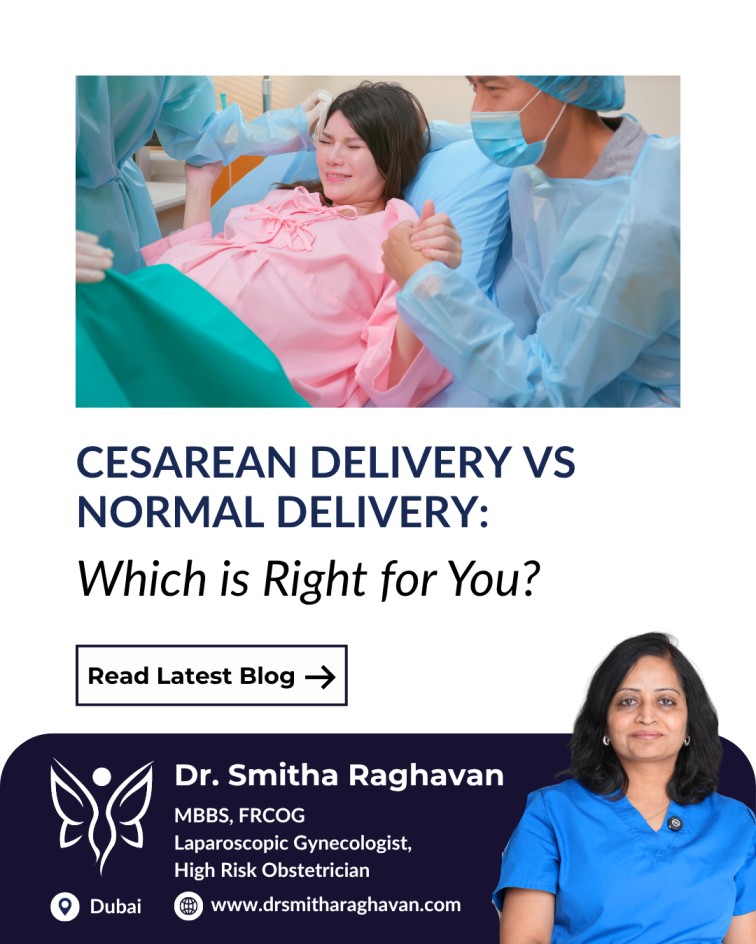
Normal delivery, also called vaginal birth, is the natural process where the baby is delivered through the birth canal without major surgery.
It usually occurs after spontaneous labor, although labor may sometimes be induced for medical reasons.
Most healthy pregnancies can safely end with vaginal delivery.
Cesarean delivery (Cesarean section or C-section) is a surgical procedure in which the baby is delivered through an incision made in the mother’s abdomen and uterus.
It is one of the most common and safest surgical procedures worldwide when performed for appropriate medical reasons.
Many cesarean deliveries are planned in advance, while others become necessary during labor if complications arise.
Feature | Normal Delivery | Cesarean Delivery |
Procedure | Vaginal birth | Surgical birth |
Hospital Stay | Usually 1–2 days | Usually 2–4 days |
Recovery | Faster | Slightly longer |
Pain After Delivery | Less prolonged | More postoperative discomfort initially |
Future Pregnancies | Usually easier recovery | Requires monitoring of uterine scar |
Surgical Risks | Minimal | Present as with any surgery |
Baby’s Recovery | Immediate skin-to-skin often easier | Slight delay possible in some cases |
Neither option is superior in every situation. The safest method depends entirely on the pregnancy.
Every pregnancy is unique.
Several factors influence the decision regarding delivery.
These include:
- Mother’s age
- Baby’s size
- Baby’s position
- Placenta location
- Previous cesarean delivery
- Maternal medical conditions
- Blood pressure
- Diabetes
- Multiple pregnancy
- Previous uterine surgeries
- Progress of labor
- Fetal well-being
A woman with an uncomplicated pregnancy may have a successful vaginal birth, while another woman with the same due date may require a cesarean for completely different medical reasons.
This individualized approach ensures maximum safety.
Normal delivery is generally preferred when:
- Pregnancy is uncomplicated
- Baby is head-down
- Labor progresses normally
- Baby is tolerating labor well
- No placenta-related complications exist
- No major maternal medical condition prevents vaginal birth
For many women, vaginal delivery offers quicker recovery and earlier return to daily activities.
A cesarean delivery may be planned or performed as an emergency.
Common indications include:
Baby in Breech Position
If the baby is feet-first or bottom-first near term.
Placenta Previa
When the placenta covers the cervix.
Fetal Distress
If the baby shows signs of inadequate oxygen during labor.
Failure of Labor to Progress
Despite adequate contractions, labor does not advance.
Previous Classical Cesarean
Certain previous uterine scars make repeat cesarean safer.
Twin or Multiple Pregnancy
Depending on the babies’ positions.
Cord Prolapse
The umbilical cord slips before the baby.
Large Baby (Macrosomia)
Especially with maternal diabetes.
Maternal Health Conditions
Including:
- Severe preeclampsia
- Certain heart diseases
- Active genital herpes infection
- Some pelvic abnormalities
Obstructed Labor
When the baby cannot safely pass through the birth canal.
Even when labor begins naturally, situations can change quickly.
Emergency cesarean may become necessary if:
- Baby’s heart rate drops
- Labor stops progressing
- Heavy bleeding occurs
- Placenta separates early (placental abruption)
- Umbilical cord complications develop
- Uterine rupture is suspected
The goal is always to deliver the baby safely while protecting the mother.
Benefits include:
- Faster recovery
- Shorter hospital stay
- Lower infection risk
- Less blood loss
- Earlier breastfeeding
- Faster mobility
- Lower risk of future surgical complications
Reduced respiratory problems in newborns
Although generally safe, complications can include:
- Perineal tears
- Heavy bleeding
- Prolonged labor
- Instrumental delivery (forceps or vacuum)
- Pelvic floor weakness
- Urinary incontinence
- Rare nerve injuries
- Shoulder dystocia
- Emergency cesarean after labor begins
Most complications are recognized early and managed promptly by experienced obstetricians.
Cesarean delivery can be lifesaving.
Benefits include:
- Safe delivery in high-risk pregnancies
- Prevents complications from obstructed labor
- Reduces risk of birth injuries in selected situations
- Planned delivery for certain medical conditions
- Better outcomes in placenta previa
Essential for some fetal emergencies
Like any surgery, cesarean delivery has potential risks.
These include:
For the mother:
- Infection
- Bleeding
- Blood clots
- Pain
- Longer recovery
- Scar formation
- Injury to nearby organs (rare)
- Adhesions
- Future placenta complications
For future pregnancies:
- Placenta accreta spectrum
- Placenta previa
- Uterine scar rupture (rare)
- Repeat cesarean requirement in some women
For the baby:
- Temporary breathing difficulties
- Rare accidental skin cuts during surgery
Fortunately, modern surgical techniques and experienced obstetric teams have made cesarean delivery extremely safe.
Recovery usually includes:
- Walking within hours
- Hospital discharge in 24–48 hours
- Mild discomfort for a few days
- Return to daily activities within weeks
Pelvic floor exercises are encouraged
Recovery generally involves:
- Walking within 12–24 hours
- Hospital stay of 2–4 days
- Pain management
- Wound care
- Avoiding heavy lifting for several weeks
- Full recovery over approximately 6 weeks
Every woman’s recovery varies.
Yes.
Many women are candidates for Vaginal Birth After Cesarean (VBAC).
Eligibility depends on:
- Type of previous uterine incision
- Number of previous cesareans
- Reason for previous cesarean
- Current pregnancy condition
- Hospital facilities
- Obstetric assessment
Not every woman is suitable, and careful evaluation is essential.
Some women request planned cesarean delivery even without medical indications.
This decision should be made after discussing:
- Benefits
- Risks
- Future pregnancy plans
- Recovery expectations
- Individual health factors
A personalized consultation helps determine the safest option.
Many expectant mothers feel disappointed if their birth plan changes.
However, pregnancy and labor are dynamic.
A labor that begins normally can develop unexpected complications requiring immediate intervention.
Experienced obstetricians make decisions based on:
- Maternal safety
- Baby’s heart rate
- Labor progress
- Ultrasound findings
- Clinical examination
- International medical guidelines
A recommendation for cesarean delivery is never made lightly. It is based on careful assessment to achieve the best possible outcome for both mother and baby.
Trusting your doctor and maintaining open communication throughout pregnancy helps reduce anxiety and ensures that decisions are made with your safety as the highest priority.
The debate between cesarean delivery and normal delivery should never be viewed as a competition. The ultimate goal is a healthy mother and a healthy baby.
While vaginal delivery is appropriate for many women, cesarean delivery can be the safest and most appropriate option in numerous medical situations.
Rather than focusing solely on the mode of delivery, it is important to choose an experienced obstetrician who carefully monitors your pregnancy and recommends the safest approach based on your unique circumstances.
If you are looking for expert guidance regarding cesarean delivery in Dubai, schedule a consultation with Dr. Smitha Raghavan to discuss the best birth plan for you and your baby.
Is cesarean delivery safer than normal delivery?
Both are safe when performed for the right medical reasons. The safest option depends on your pregnancy.
Is a cesarean delivery always planned?
No. Some are scheduled, while others become necessary during labor because of unexpected complications.
Can I choose a cesarean delivery even if there is no medical reason?
In some situations, yes. Your doctor will discuss the benefits, risks, and future pregnancy implications before making a decision.
Is recovery longer after a C-section?
Yes. Recovery after cesarean delivery usually takes longer than recovery after vaginal birth.
Can I have a normal delivery after one cesarean?
Many women can have a successful VBAC, depending on their previous surgery and current pregnancy.
Does a cesarean affect future pregnancies?
It can increase the risk of placenta-related complications and uterine scar issues in future pregnancies, which is why careful planning is important.
Does normal delivery always involve severe tearing?
No. Many women have minimal or no tears, and any tears that occur are repaired immediately after birth.
Which delivery method is less painful?
Normal delivery involves pain during labor, while cesarean delivery avoids labor pain during surgery but has postoperative pain during recovery.
How do doctors decide the best delivery method?
The decision is based on maternal health, baby’s condition, labor progress, previous obstetric history, ultrasound findings, and overall pregnancy risk.
When should I consult an obstetrician in Dubai?
Ideally, as soon as pregnancy is confirmed. Regular antenatal visits help ensure timely monitoring and appropriate delivery planning.
0
+
Years of Experience
0
+
Babies Delivered
0
+
Surgeries Performed
Consult
Dubai’s Best Gynecologist
Address
• Mediclinic Welcare Hospital, Al Garhoud, Dubai, UAE.
• Mediclinic Deira, City Centre Officer Building, Port Saeed, Adjacent to Pullman Hotel, Dubai, UAE.
For Appointment
+971 54 439 2994
smithardoc@gmail.com

Dr. Smitha Raghavan M.V.
MBBS, FRCOG, CCT (UK),
MSc IHML Laparoscopic Gynecologist &
High-Risk Obstetrician
Specialist Care in Laparoscopy and High-Risk Obstetrics.
Latest Blogs

Concerned about infertility in Dubai? Learn the common causes of infertility, how lifestyle changes improve fertility, and why laparoscopy plays a crucial role in diagnosis and treatment. Expert insights from Dr. Smitha Raghavan.

Looking for PCOS treatment in Dubai? Learn why PCOS is now called PMOS, symptoms, causes, infertility treatment, and expert care by Dr. Smitha Raghavan, laparoscopic gynecologist in Dubai.

Learn how fibroids affect fertility, their symptoms, diagnosis, and advanced laparoscopic fibroids treatment in Dubai by Dr. Smitha Raghavan.
Services
Pregnancy Care
Complete antenatal and postnatal care for expectant mothers, from low-risk pregnancies to complex high-risk pregnancies involving diabetes, high blood pressure, previous pregnancy loss, premature deliveries, or growth-restricted babies.
Gynecology Treatments
Comprehensive care for women’s health issues including infertility, fibroids, endometriosis, PCOS, menstrual disorders, ovarian cysts, abnormal bleeding, and hormonal imbalances—using evidence-based medical and surgical treatments.
Infertility Care
Personalized evaluation and treatment for female infertility caused by ovulation problems, tubal blockage, endometriosis, PCOS, or unexplained causes, with a strong focus on restoring natural fertility and improving pregnancy outcomes.
Laparoscopic Surgeries
Advanced laparoscopic gynecologic surgeries including laparoscopic hysterectomy, myomectomy, endometriosis surgery, ovarian cystectomy, ectopic pregnancy management, and fertility-preserving procedures for faster recovery.
FAQ
Frequently Asked Questions
1. Where can I consult with Dr. Smitha Raghavan for gynecological concerns in Dubai?
Dr. Smitha Raghavan M.V. is a Consultant Gynecologist practicing at Mediclinic Welcare Hospital and Mediclinic Deira, Dubai. Patients seeking world-class care in a premium hospital setting can easily book appointments at these locations for both routine check-ups and advanced surgical consultations.
2. What are the advantages of choosing Laparoscopic Surgery (Keyhole Surgery) in Dubai?
As a leading Laparoscopic Surgeon in Dubai, Dr. Smitha utilizes minimally invasive techniques for treating fibroids, ovarian cysts, and endometriosis. The primary benefits for our patients include significantly less postoperative pain, minimal scarring, a lower risk of infection, and a much faster return to daily activities compared to traditional open surgery.
3. What qualifies a pregnancy as "high-risk," and how is it managed?
A pregnancy is considered “high-risk” if there are potential complications affecting the mother or baby, such as gestational diabetes, hypertension (pre-eclampsia), or multiple births (twins) etc. As a High-Risk Obstetrician in Dubai, Dr. Smitha provides specialized monitoring and personalized birth plans to ensure the safest possible outcome for complex pregnancies.
4. Do you offer second opinions for gynecological surgery in Dubai?
Yes. Many patients visit Dr. Smitha at Mediclinic for a second opinion regarding hysterectomy or fibroid surgery. As an expert in advanced laparoscopy, she specializes in providing minimally invasive alternatives to traditional open surgery.
5. How can I prepare for my first consultation at Mediclinic Dubai?
For your first visit, please bring any previous medical records, recent ultrasound reports, or blood test results. Whether you are visiting for gynecological surgery or antenatal care, Dr. Smitha ensures a comprehensive evaluation. You can contact us at +971 54 439 2994 to confirm an appointment.